
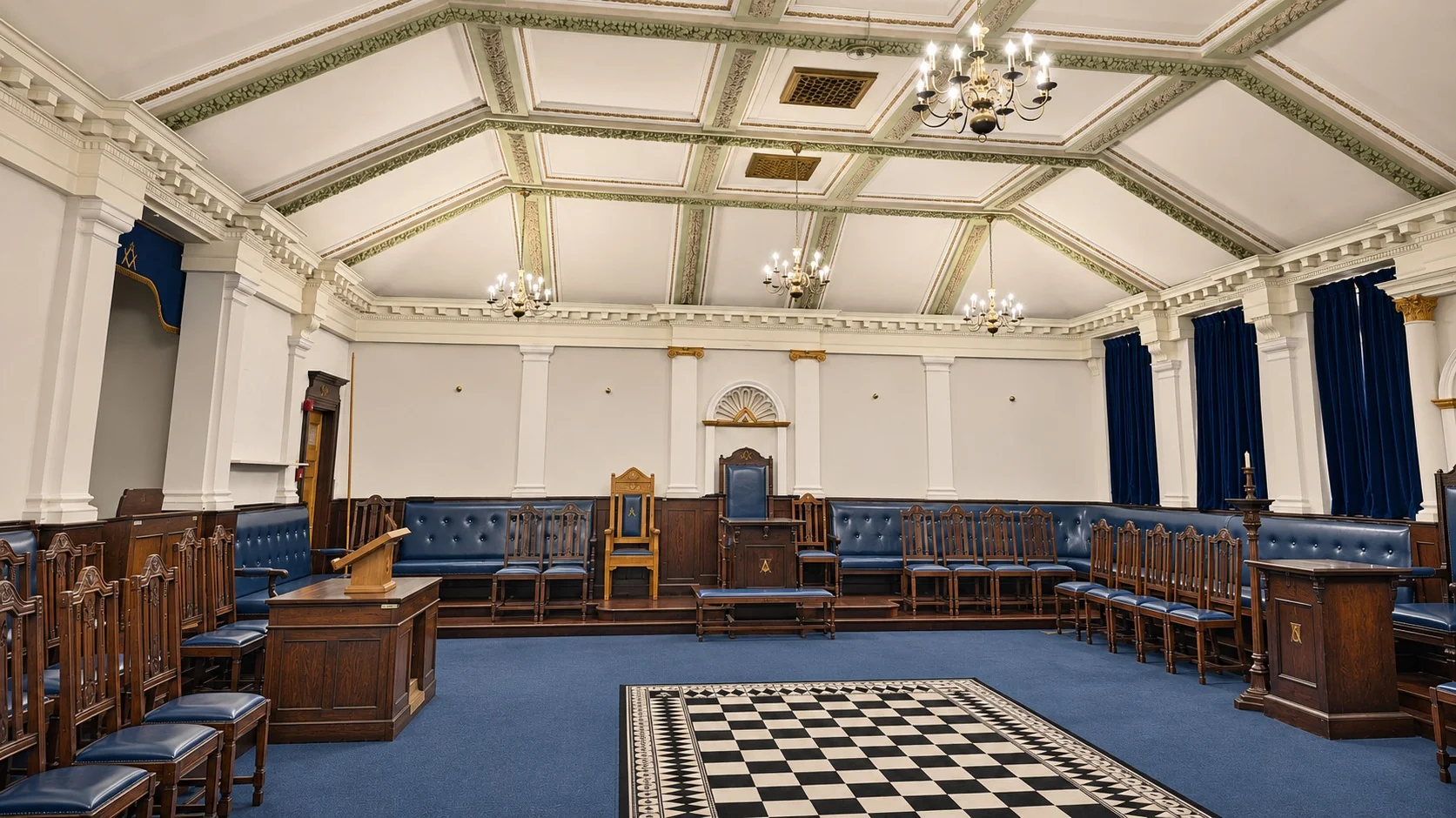

From working stone to working on ourselves.
The origins of Freemasonry are debated. The widely accepted connection is with the medieval stonemasons who built castles and cathedrals. The change from a working craft into a society using that craft’s tools and stories was a gradual development.
In modern Freemasonry, the building is a metaphor. A rough stone becoming a well-shaped one offers a way to think about learning, conduct and the contribution a person makes to the people around them.
How the story took shape.
An early English record
Elias Ashmole recorded his initiation in Warrington, an important early record of English Freemasonry. Read the source.
The first Grand Lodge
Four London lodges formed the first Grand Lodge, a milestone in organised English Freemasonry. Read the source.
The Constitutions
The first Constitutions gave the developing organisation a published framework. Read the source.
Cheshire becomes a Masonic Province
Cheshire’s provincial history begins in 1725. The Province, which includes the Wirral, is recognised as the oldest in the United Grand Lodge of England. Read the source.
The United Grand Lodge of England
Two rival English Grand Lodges united to form UGLE. Read the source.
The roots of the Order of Women Freemasons
The organisation now known as the Order of Women Freemasons was founded on 20 June. Initially admitting men and women, it later became exclusively female. Read the source.
A second women’s Grand Lodge
The Honourable Fraternity of Ancient Freemasons was established, now also known as Freemasonry for Women. Read the source.
Growth after the First World War
More than 350 new lodges were established in the three years following the war, reflecting renewed demand for fellowship. Read the source.
A memorial in London
Freemasons’ Hall in London was completed as a memorial to members who died in the First World War. Read the source.
A new Grand Master
The Duke of Kent was installed as Grand Master during Grand Lodge’s 250th anniversary celebrations at the Royal Albert Hall. Read the source.
A more public celebration
Press and television attended Grand Lodge’s 275th anniversary gathering at Earl’s Court, bringing the occasion to a wider audience. Read the source.
Charity comes together
The Masonic Charitable Foundation was established, bringing together the work of four central Masonic charities. Read the source.
Three hundred years of Grand Lodge
Tercentenary celebrations included a major gathering at the Royal Albert Hall. Read the source.
Service during the pandemic
Freemasons across England and Wales organised food donations, deliveries and freshly cooked meals for vulnerable people during the COVID-19 pandemic. Read the source.
Cheshire marks three centuries
Cheshire celebrated its tercentenary, including events in Chester on 7 June and a historically styled initiation in London on 12 June. Read the source.
What happens in a Lodge?
A Lodge is a group of members. Its meetings combine practical business with ceremonies that use stories and symbols to explore moral ideas. Members also make time to share a meal and enjoy each other’s company.
A Lodge and a Masonic Hall are different things: the Lodge is the body of people, while the Hall is a building that can be used by several Masonic bodies. Royal Arch Chapters and other Orders have their own organisation and visiting requirements.
Four values in everyday life.
United Grand Lodge of England describes its values as integrity, friendship, respect and service. In practice, these can be expressed in dependable conduct, lasting friendships, consideration for others and giving time or resources to community life.
The ceremonies give those ideas a memorable form. Charity and volunteering give them a practical expression beyond the meeting room.
Symbols as a language of ideas.
The square, compasses and mason’s apron reflect the craft from which Freemasonry draws its imagery. They are used in a different setting today, encouraging reflection on behaviour, responsibility and improvement.
Like the classical references in the Hall’s rooms, the symbols are best understood in context. Their meaning comes from tradition and explanation rather than sensational stories.
Your questions, answered.
Is Freemasonry a religion?
Freemasonry is not a religion and does not replace a member’s faith. UGLE membership has a requirement for belief in a Supreme Being; detailed eligibility is explained by UGLE and the relevant Grand Lodge.
Can women be Freemasons?
Yes. England has independent Grand Lodges for women, including the Order of Women Freemasons and the Honourable Fraternity of Ancient Freemasons. UGLE provides information and links to them.
Can anyone attend a Lodge meeting?
Meetings have membership and visiting requirements. An arranged heritage visit is a separate opportunity to learn about the building.
Do I need to join to hire a function room?
You can enquire about the Hall’s public function rooms without becoming a Freemason. Availability, suitability and booking terms apply.